

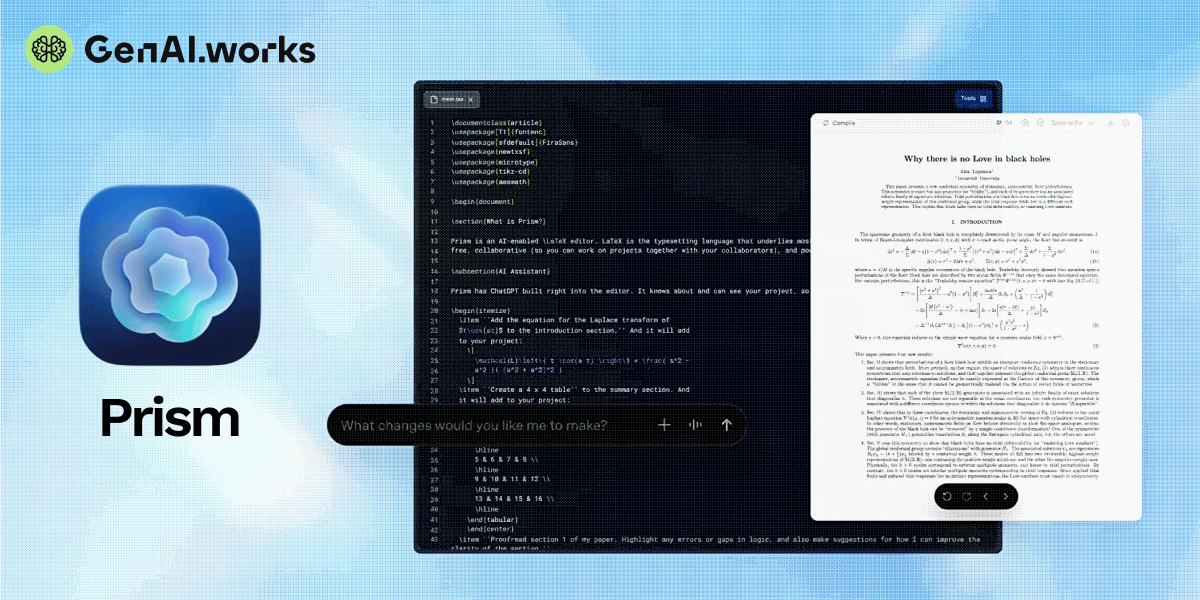
With this, AI can see the draft, equations, citations and figures in one place. It is promoted as a free workspace for scientists, powered by AI, with no limits on projects or collaborators, accessible to anyone with a ChatGPT account. This implies that if Prism becomes the primary platform for writing papers, OpenAI will expand its influence beyond chatbots to include scientific writing tools. Here is what the launch details reveal: Access: Unlimited collaborators and projects, eliminating the typical seat-limit friction.
The advantage is faster speeds and fewer tool hops, but this could potentially create dependence on a single service provider, which may pose a risk in terms of data security and privacy. Considering the risks, it is crucial to think about the impact of depending solely on one platform for your scientific tasks, as any service interruptions could have serious outcomes. If OpenAI continues to offer this service for free, users may develop a reliance that could lead to the introduction of paywalls for premium features later on. Want to get the most out of ChatGPT? ChatGPT is a superpower if you know how to use it correctly.
Discover how HubSpot's guide to AI can elevate both your productivity and creativity to get more things done. Learn to automate tasks, enhance decision-making, and foster innovation with the power of AI. Download the free guide NASA: AI Finds 800+ New Discoveries in Hubble Vault NASA and ESA researchers reopened Hubble’s (a space telescope) giant photo vault and approached it as a mystery to solve. They trained an AI system called AnomalyMatch to analyze nearly 100 million tiny image cutouts and flag anything that looks unusual. No team of humans can manually analyze such a large amount of data and newer telescopes will produce far more.
The simple fact is that we cannot comb old data at scale while the next wave of telescopes will flood us with discoveries we never notice. Here is the result of the deep dive: Speed: It scanned the dataset in about 2.5 days and surfaced 1,300+ odd objects for human review.
The European Space Agency (ESA) data scientist calls it a powerful demonstration of how AI can enhance the scientific return of archival datasets. The catch is that identifying unusual objects depends on what the model calls weird, so the field will need transparency, audits, random reviews and rechecks. If this becomes the common process for space telescopes and observatories like Roman, Euclid and Rubin will need open methods and routine human spot checks.
For users like Lucy Edwards, apps such as Be My Eyes act as digital mirrors that translate skin texture and makeup application into descriptive text. This process offers a subjective evaluation of human appearance, going beyond mere obstacle detection. Neural networks, trained on existing data, project the sighted world's aesthetic pressures and body image anxieties onto how they interpret faces. Here is what the reporting shows in detail: Routine: Edwards uses five products, then sends photos to check the result as if it were a mirror.
People with normal sensory responses use these apps to edit themselves to match a standard. However, blind users get the standard delivered to them, word for word. Envision’s CEO says many users ask 'how do I look' first, which tells you this product is really competing with beauty culture and the collapse of mental health. The spread of 'AI mirrors' with standardization of beauty and facial detail narration, the question would be about individuality.
Unlike browser-only AI, Moltbot runs on your own computer and connects to chat apps like WhatsApp, Telegram, Slack, Discord, Signal, or iMessage so you can interact with it the way you already text. It is designed to go beyond answers and actually perform tasks for you. Core functions (and how to use them): Repo refactor: Point it at a codebase folder. Ask it to rename functions, split a long file into modules, update imports, and write a changelog so you can review the diff cleanly.
Spreadsheet cleanup: Drop a CSV export into a folder. Tell it to standardize headers, fix date formats, dedupe rows, and export a new cleaned CSV you can upload back into Sheets. File-based drafting: Give it a folder of notes, PDFs, or meeting transcripts. Ask it to extract key points, generate a one-page summary, and save it as brief.md or outline.doc . Automations with schedules: Set up a daily task like “scan yesterday’s logs, list top errors, and save daily_ report.md ,” so you get a fresh artifact without repeating yourself.
Web-to-structured output: Tell it to open a webpage, pull specific fields (pricing tiers, feature lists, policy changes), and save the results into a JSON or CSV you can reuse. How to try it: Create a folder with one messy CSV and one small code file. Ask Moltbot to clean the data, refactor the code, and save a short explanation of changes. Opening those files confirms a repeatable workflow ready for real projects.