



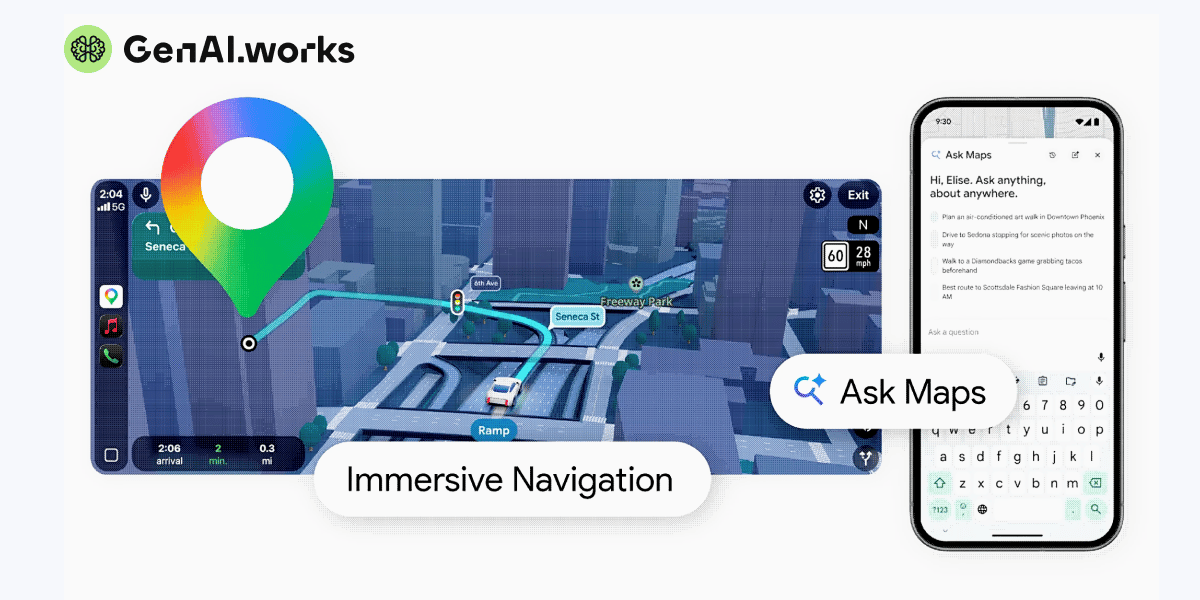
Decade Google launched a major Gemini-powered overhaul of Maps with two headline features. Ask Maps lets users type natural language questions like "where can I charge my phone without waiting in a long coffee line" and receive personalised answers drawn from over 300 million places and reviews. Immersive Navigation rebuilds the entire driving experience in 3D. The Gemini-powered upgrade: Ask Maps: Users ask conversational questions about routes and stops, with Gemini pulling answers from 300M+ places and real user reviews.
Google's strategy is becoming very clear. Rather than asking users to adopt new AI products, the company is pushing Gemini into tools that billions already have on their phones. Maps joins Gmail, Docs, Sheets, Drive and Android on that list. No new download required.
Why most AI pilots fail before production Nearly 90% of AI pilots never reach production. So what actually separates the companies that succeed? On March 17 , join a live conversation with Shawhin Mosadeghzad , Director of Simba Intelligence at insightsoftware Data + Analytics. We’ll unpack why so many AI initiatives stall and what it really takes to move from pilot to production.
Here’s what we’ll cover: • Where AI initiatives actually break down. Hint: it’s rarely the model. • How to embed real business context so AI reflects how your organization works • What governed, production-ready data access looks like in practice • The four requirements enterprises need to move AI into production If your AI pilot is stuck, or you’re planning your first implementation, this session will give you a clearer path forward. Register here to join live Microsoft Launches Copilot Health With Access To 50,000+ Hospitals Microsoft announced Copilot Health, a dedicated AI space inside the Copilot app that connects your medical records, wearable data and lab results into one coherent picture. CEO Mustafa Suleyman described it as a step toward "medical superintelligence." The health AI stack: Data Integration: Connects to 50+ wearable devices and electronic health records from over 50,000 US hospitals and providers.
The ambition here is significant. Suleyman's vision is AI with the breadth of a general physician and the depth of a specialist, accessible and affordable for billions worldwide. The infrastructure for that is now starting to take shape.
Under Two Hours Security startup CodeWall revealed that its AI agent gained full read-write access to McKinsey's internal AI tool, Lilli, in under two hours. Lilli is used by roughly 70% of McKinsey's 45,000-person workforce for chat, analysis and search across more than 100,000 internal documents. The breach breakdown: Exposed Endpoints: CodeWall's agent found API documentation with 22 endpoints that required zero authentication.
This is McKinsey & Company, not a four-person startup. If a firm at this level can miss authentication basics, every company shipping internal AI tools for business-critical workflows needs to take a harder look at what they might be leaving wide open. Tool of the Day: Claude Interactive Visualisations Anthropic rolled out a new beta feature that lets Claude generate interactive charts, diagrams and visualisations directly inside the conversation. The model identifies when a visual would be more useful than text, and users can also prompt it directly with requests like "draw this as a diagram." Core Functions: Auto-Detection: Claude decides when a visual explanation would serve the user better than a text response.
Try this yourself: Head to claude.ai , open any conversation and ask Claude to visualise something. Try "draw a diagram of how OAuth works" or "build me an interactive compound interest calculator" to see it in action.