



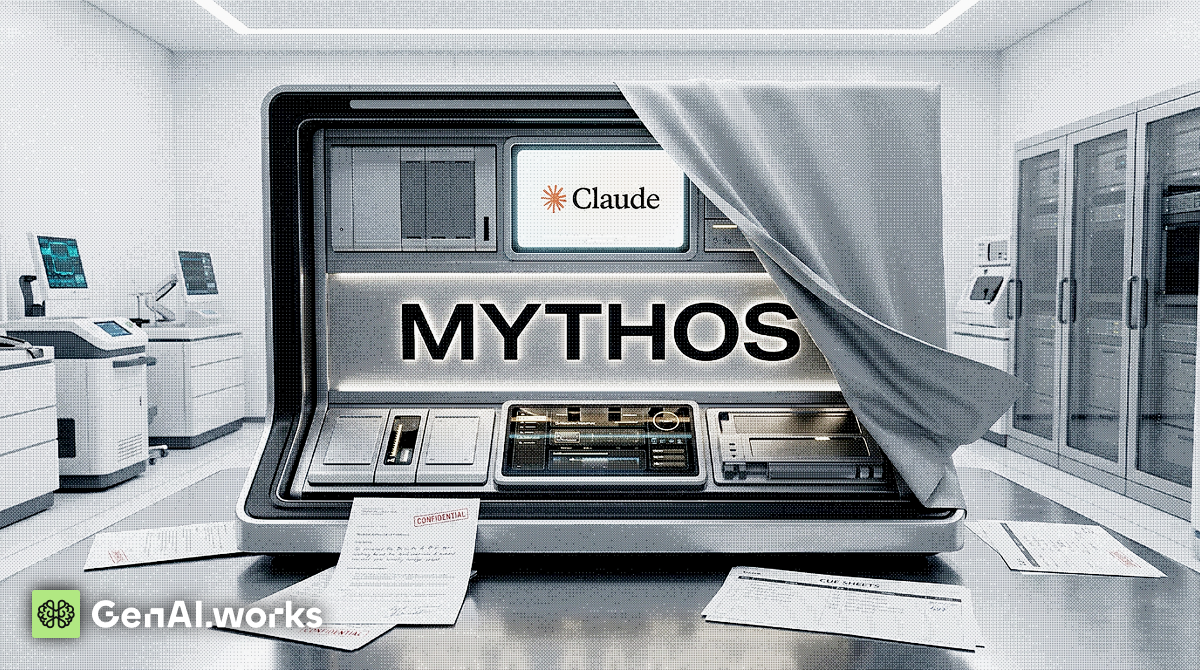
Internal documents describing Anthropic's next flagship AI surfaced last week after a configuration error left thousands of unpublished assets in a publicly accessible data store. Among them was a draft blog post revealing a model called Claude Mythos and a new tier called Capybara that sits above Opus .
The details:
How It Leaked: A CMS misconfiguration exposed around 3,000 unpublished assets, including draft blog posts and internal content that had not been approved for release.
New Tier: Capybara represents a new model class larger and more capable than Opus, which was previously Anthropic's most powerful offering. It is also more expensive to run.
Capabilities: Anthropic described the model as a step change in performance, with dramatically higher scores in coding, academic reasoning and cybersecurity compared to Claude Opus 4.6.
Cyber Risk: The draft flagged the model as currently far ahead of any other AI system in cybersecurity capabilities, warning it could help attackers outpace defenders.
Market Impact: The iShares Expanded Tech-Software Sector ETF dropped nearly 3% on Friday. Cybersecurity stocks have been under pressure all year on fears that new AI will disrupt the sector.
Anthropic confirmed to Fortune that it is testing a new general-purpose model with meaningful advances in reasoning, coding and cybersecurity. No release date has been announced. Whether the leak was genuinely accidental or a well-timed preview is a question the company has not addressed.
AI agents are changing enterprise workflows. From knowledge work to customer experience.
Unlike traditional automation, they can reason, plan, and act. Even across complex tasks using company data.
With Vectara on-premise, agents run inside your infrastructure. You keep full control over data, governance, and performance. It also supports production-ready AI.
Vectara delivers value across four areas: security, compliance, predictability, and cost.
Your data stays within your perimeter. Air-gapped options are available for regulated industries like healthcare, finance, defense, and semiconductors.
A federal judge in San Francisco blocked the Trump administration's designation of Anthropic as a supply chain risk, handing the company an early legal victory in its standoff with the Pentagon.
The details:
The Ruling: US District Judge Rita Lin granted a preliminary injunction on Thursday, barring federal agencies from enforcing the blacklisting while the case proceeds.
First Amendment: Lin wrote that punishing Anthropic for bringing public scrutiny to the government's contracting position amounts to illegal First Amendment retaliation.
Background: The dispute centres on Anthropic's refusal to grant the Pentagon unrestricted access to Claude. The company drew two red lines: no autonomous weapons and no domestic mass surveillance.
Wider Fallout: The supply chain risk label required defence contractors including Amazon, Microsoft and Palantir to certify they did not use Claude in their Pentagon work.
The injunction does not resolve the underlying dispute. A parallel case is still pending in Washington DC, and the Pentagon has signalled it intends to appeal. But for now, Anthropic can continue operating across federal agencies and contractor partnerships.
Google launched new switching tools that let Gemini users import memories, preferences and full chat histories from other AI platforms. The move is a direct play to reduce the cost of leaving ChatGPT or Claude.
The details:
Memory Import: Gemini generates a prompt you paste into your current chatbot. That chatbot summarises what it knows about you. You paste the summary back into Gemini and it builds a profile of your preferences, interests and personal context.
Chat History Import: Users can export conversation logs from other platforms as zip files (up to 5GB) and upload them directly into Gemini via settings.
Availability: Both features are live now for free and paid consumer accounts globally.
The Numbers: ChatGPT reported 900 million weekly active users last month. Gemini said it had surpassed 750 million monthly active users during Alphabet's Q4 earnings call. The gap is closing but ChatGPT still leads on engagement.
The strategy is transparent. Google cannot win the model war on benchmarks alone, so it is removing the single biggest barrier to switching: losing months of accumulated context. Whether users actually care enough to migrate is the open question.
The Wall Street Journal published a detailed investigation tracing the rivalry between Sam Altman and Dario Amodei back to a San Francisco townhouse in 2016, revealing personal grudges that are now shaping two companies valued at more than $300 billion combined.
The details:
Origins: Dario Amodei joined OpenAI in 2016 and became a key developer behind GPT-2 and GPT-3. Tensions with co-founder Greg Brockman and Altman grew over credit, power and the pace of development.
Breaking Point: Brockman reportedly once proposed selling AGI access to UN Security Council nuclear powers. Amodei considered the idea tantamount to treason. A separate confrontation saw Altman allegedly accuse the Amodeis of plotting against him to the board, then deny it when confronted.
Private Language: Amodei privately compared the Altman-Musk lawsuit to a conflict between Hitler and Stalin, called Brockman's pro-Trump PAC donation evil and likened OpenAI to Big Tobacco.
Departure: Amodei left OpenAI in late 2020. He later told associates he felt psychologically abused by Altman. Altman told colleagues the tension was making him hate his job.
The personal wounds have never healed, and the WSJ investigation makes clear they are actively steering decisions at both companies. From Pentagon contracts to Super Bowl adverts to the awkward refusal to hold hands at the India AI Summit, the grudges are not just entertaining. They are shaping the trajectory of the most consequential technology race in decades.
Tool of the Day: Decksy
Decksy generates researched, professional slide decks from topics, text or uploaded documents.
What it does: You provide a topic, paste in text or upload a document and Decksy builds a complete presentation with structure, content and design.
Why it matters: Slide creation is one of the most time-consuming tasks in any knowledge worker's week. Decksy compresses the research-to-deck pipeline into minutes.
Try it yourself: Decksy
Eli Lilly e ntered a $2.75B deal with Hong Kong's Insilico Medicine to license its AI-discovered drug pipeline, with 28 compounds already in development.
xAI 's Ross Nordeen departed the company this week. He was the last remaining original co-founder besides Elon Musk.
Google expanded its Live Translate feature to iOS, turning any pair of headphones into a real-time interpreter across 70+ languages.
OpenAI launched Codex plugins that bundle skills, workplace apps and MCP servers into reusable workflows, mirroring functionality already available in Claude Code.